
#Four-dimensional space (4D)
This page collects and organizes information about the fourth dimension: how to understand it, how to picture it, and other interesting things.
Join the discussion in the Telegram chat: https://t.me/metageometria (in Russian)
#What is it?
4D, four-dimensional space, the fourth dimension - an abstract concept of a space that generalizes the properties of 3D, 2D, 1D and 0D to dimension 4.
We think of four-dimensional space first and foremost as something as similar as possible to our three-dimensional space, but with 4 dimensions. It doesn't matter how it might be implemented in math or in programming; what matters is that it stays similar in spirit to the three-dimensional world.
You can find out how something should work in 4D by drawing an analogy for the step from 3D to 4D, based on your understanding of the step from 2D to 3D.
Also, you won't find any hypotheses here about the fourth dimension of our world holding heaven and hell or parallel worlds: that's completely uninteresting and unprovable, so go take that nonsense to Ancient Aliens.
As a mathematical model of four-dimensional space for calculations and simulations, Euclidean space and analytic geometry work perfectly.
#FAQ
#2What about time? Time is the fourth axis, right? That's what Einstein said.
Don't mix up apples and oranges. Four-dimensional space is first and foremost an abstract concept that exists on paper, in programs and in people's minds. 4D doesn't depend on our world in any way.
And time as the fourth axis is one of the practical applications of abstract four-dimensional space in physics. But what's used there isn't pure 4D, it's Minkowski space.
#24D is only time!
Saying that 4D is exclusively spacetime is as meaningless as saying that the number 2 means only those 2 stones, and not 2 joules, not 2 photons, not 2 bits, not 2 x's.
The number 2 is a much broader concept than its particular realization as two particular objects.
Likewise, 4D is a much broader concept than its realization as spacetime.
#2But I went to a 7D cinema!
That's marketing nonsense, and it has nothing to do with a real 7D space.
Of course, the extra sensations do add an extra dimension of sensation while you watch, but that, again, is just a special case of using multidimensional spaces in real life, and the fact that you've watched a "7D movie" doesn't mean you can imagine 7 spatial dimensions.
You might as well say that our eyes actually see not a 2D picture but a 3.7D one, since we see with two eyes, with depth, with color, with time.
#2Why 4D in particular, why not 5D or a gazillion-D?
Any space > 3D is already more interesting than 3D. And 4D is easier to visualize, compute and understand than 5D and all the higher spaces. So 4D is the sweet spot between interesting and simple.
#24D doesn't exist!
Claiming that 4D doesn't exist is as meaningless as claiming that the number 2 doesn't exist. 4D is an abstract concept that doesn't depend on our world.
If you want to say that "our world isn't a geometric 4D space", then say exactly that.
If you want to say that "our world doesn't work according to the idea of spacetime", then say exactly that too.
#2In 4D, will we see both the surface and the insides of all objects at once?!
Next you'll tell me we'll see things "from all sides at once". No: in 4D, just like in 3D and 2D, we'll see only the surface of 4D objects. But we will be able to see the insides of 3D objects, because there 3D will be flat, and vision will be 3D. It will work the same way we see the insides of 2D objects in 3D.
#2So what is 3D vision like?
Vision takes an image as input, and the dimension of the image determines the dimension of vision.
Now let's figure out: what are 0D, 1D and 2D images?
- 0D is 1 pixel.
- 1D is a one-dimensional array of pixels.
- 2D is a two-dimensional array of pixels.
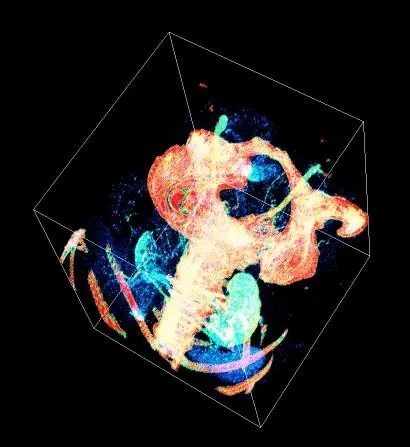
Then a 3D image is a three-dimensional array of pixels, or rather voxels. And it can be visualized like this:

jpg
We see this picture with our 2D eyes, so some details are hidden behind others. If we had 3D vision, we would see it just as clearly, with all its insides, as if we were looking at a flat picture.
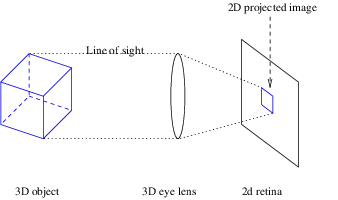
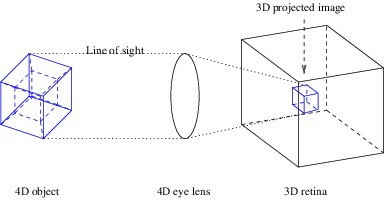
Also, seeing with 3D vision is roughly like looking at a person and instantly seeing their CT scan. Yes, 4D beings see all our insides, just as we see all the insides of 2D beings.
And you can see it in this picture:
png
png
#2We have two eyes, so what if we add a third one? And how many eyes would you need in 4D space?
Your screen is flat. No matter which eye you look at it with, it looks the same. And somehow, looking at it, you manage to see three-dimensional pictures, be it games, movies, etc. So we conclude that a single eye should be enough to see space.
But if you add more eyes, you simply gain the ability to see "distances" to objects. Extra eyes won't give you true 3D vision.
#2Well, when I eat some shrooms, I see sooo many spatial dimensions too!
No, these substances can't make the brain compute 4D geometric transformations so that it can then project them and draw them correctly. Substances can only give you gibberish, or a statistically plausible picture (the kind neural networks sometimes draw).
Now, if you had already understood 4D visually before that, had formed enough neural connections to recognize and picture it, and then took the substance - that's a different story.
#2Why can't we imagine 4D?
Because we have no visual examples. We can reconstruct 3D objects from their shadows because we've seen lots of 3D objects and their shadows (hello, neural networks). But we've never seen 4D objects, so we can't imagine what a 4D object looks like from its "shadow" (projection) alone.
Answer shamelessly stolen from here.
#How to understand it?
#2Logically
It's pretty simple. Just study the following materials:
- The Dimensions films - simply a must-see. They explain not only dimensions of space, but also a bit about complex numbers and projections.
- Website
- YouTube playlist - more convenient to watch there.
- The book Flatland - a work of fiction that not only gives you an understanding of dimensions in general, but also has an interesting political and social subtext of its time. Recommended reading even for those who already understand 4D. It usually comes together with the book "Sphereland", written by a different author, which explains the concept of the expanding universe.
- Link on Telegram (in Russian)
- An explanation of 4D visualization - highly recommended, I stole lots of pictures from there.
#3The tesseract
When explaining 4D, everyone loves to use the example of the cube and the tesseract.
A tesseract is a four-dimensional cube.
You might ask: where is its inside? This can be shown with GIFs:
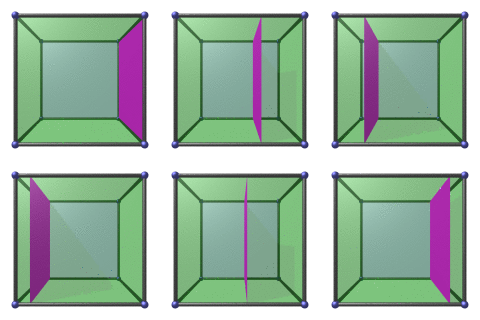
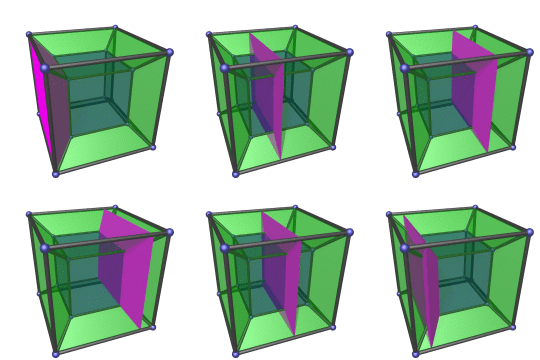
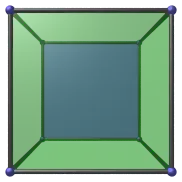
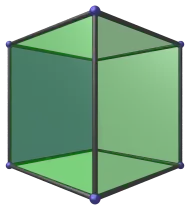
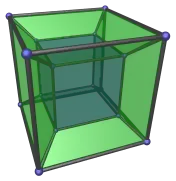
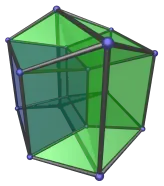
Why does the rotating tesseract in the GIF look as if it's passing through itself? Because the projection of a cube also looks like a square passing through itself. Compare:
png
png
png
png
The pictures are taken from here.
#2Visually
People quite often ask something like this:
OK, fine, I get that a tesseract has M vertices, N edges, K 2D faces and L 3D faces, and I can even calculate how many a five-dimensional cube will have. But how do I picture it in my head? How do I rotate it in my mind and see the hypervolume?
At the moment, I personally don't know of anyone who has managed to imagine four-dimensional space the same way we imagine three-dimensional space.
To truly understand four-dimensional space visually, you need to learn to do the same visual operations we can do with three-dimensional space, and to understand what our familiar things would look like in an unfamiliar four-dimensional world.
I have a hypothesis that to understand 4D you need to play a 4D game projected onto a three-dimensional image, for example a 4D Minecraft. In this game, the result of rendering should be a 3D voxel image with perspective projection. Then we'll draw this 3D image on a 2D screen and try to make it out.
Under development...
#Interesting stuff
#24D geometric shapes
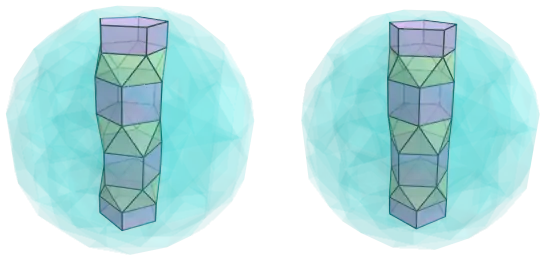
You know about regular polyhedra and semiregular polyhedra in three-dimensional space, right? Four-dimensional space has plenty of its own too, and there's a whole website that visually shows what they look like from different angles, along with their mathematical properties and explanations.
png
Honestly, I have no idea how they managed to calculate all these shapes, it's just mind-boggling. There must be some very complicated math behind it. Too bad they wrote the coordinates of the shapes in such an inconvenient format.
#24D Toys

This is a game where you can interact with 4D objects, including in VR.
The only thing I hate about this game is the projection they use. They use cross-sections - slicing an object with a hyperplane. The video shows this in detail.
I think that for simple visualization it does work, of course, but for understanding 4D space it doesn't work at all. For understanding 4D, perspective projection is perfect. It's exactly the one that fits, because too much of geometry and of spatial concepts in general is tied to how this projection works.
What's more, with their projection:
- You can't look at the surface of a four-dimensional object, you can only see a small part of it;
- You can't look into the distance
With this projection, you won't understand where your item fell, because you won't see what's to the side of you.
#Unsorted
#2A video on how to draw a tesseract and what it actually is

#2Folding a tesseract from its net
A 3D net of a tesseract is taken and folded into a 4D cube, all by analogy with the 2D net of a 3D cube.

#2How the 120-cell is assembled
The 120-cell is a regular 4D shape made entirely of dodecahedra, which in turn are made of regular pentagons.

This is a very beautiful video that shows how this shape is assembled from its net.
#2Wandering around 2D space
png
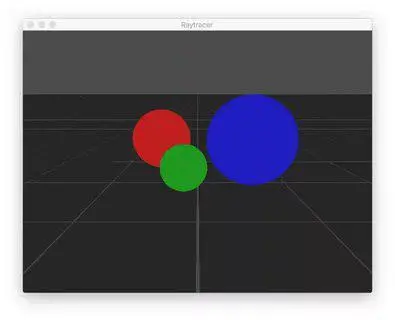
You're given 360-degree 1D vision, and you have to wander around a 2D world with it. Overall the game is good, it just badly lacks lighting: without it, you can't tell a corner of a shape from a straight side, which makes it harder to find your way. In 3D, this way of drawing would look like this:
jpg
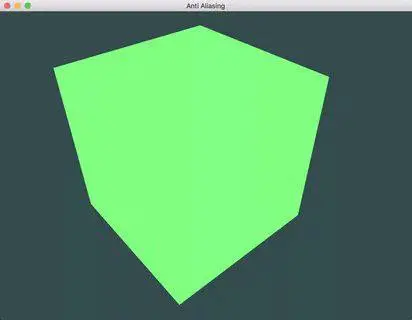
jpg
Also, the GIFs there show nicely how the projection works.
You can play the game here.
If you make your own 2D game, do it with 2D ray tracing from the start, so it has lighting, optical refraction and everything. The same goes for your own 4D game.
#2For a laugh

#2Assorted spatial stuff

The video (in Russian) isn't perfect, but it has lots of interesting bits and cool visualizations.
In this video, Yan Toples brings together everything spatial and geometric. Here's a list of topics that affect space and geometry in some way:
- Portals
- Non-Euclidean worlds. Implemented with portals. There's no hyper-geometry there: all these rooms are simply located somewhere else, and the portals teleport you to the right place.

- Portal in a portal. (in Russian) - my work.
- Portals are not non-Euclidean geometry! (in Russian)
- Higher and lower dimensions
- Spherical geometry
- A cool video about stereographic projection. Taken from here.
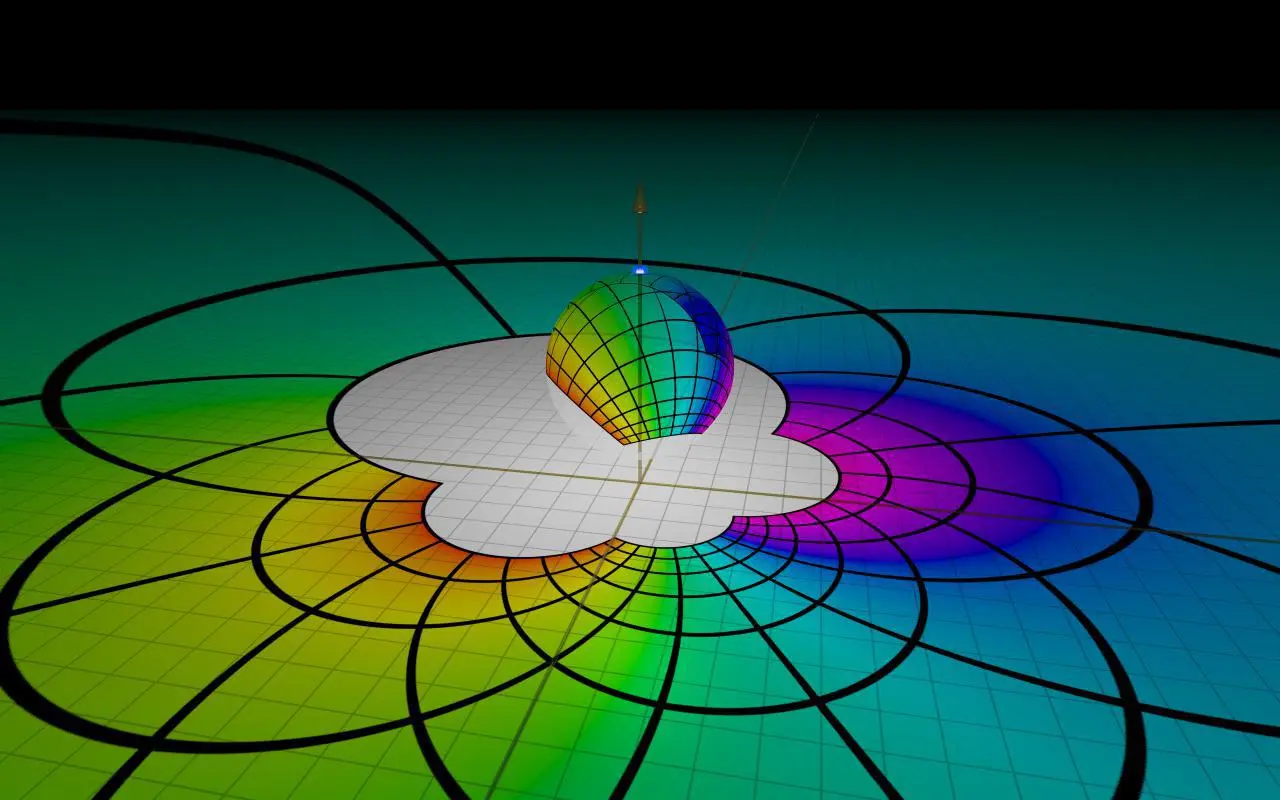
jpg
- Hyperbolic (Lobachevskian) geometry
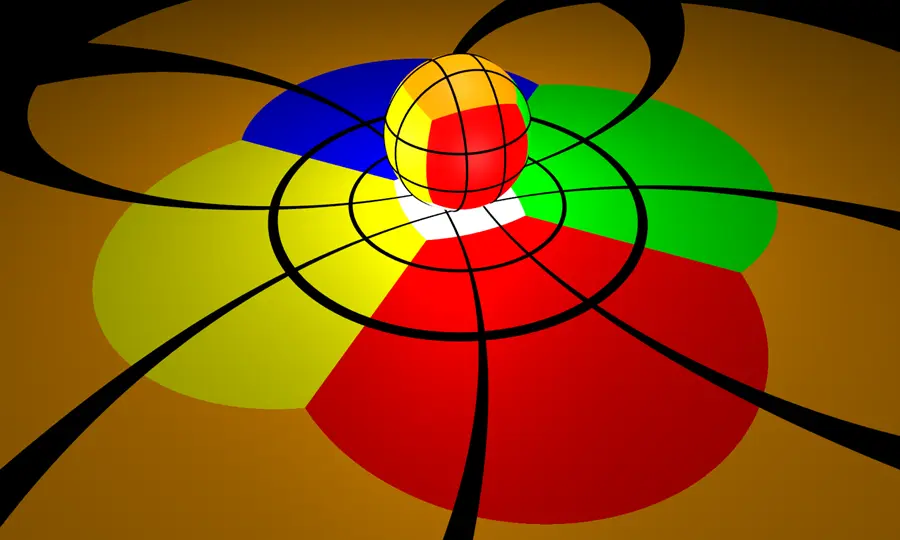
png
#2List of four-dimensional games
#24D forum
#2An explanation of how projections work
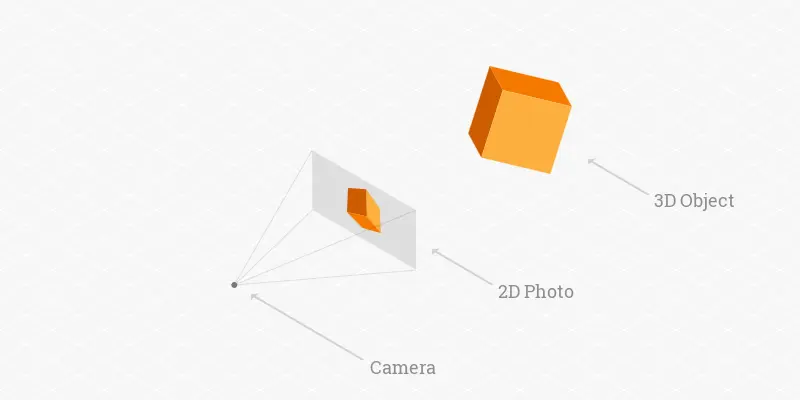
png
#2Ray tracing four-dimensional space
https://habr.com/ru/post/114698/ (in Russian)
https://habr.com/ru/post/113485/ (in Russian)
Changelog
2021.08.26
Moved this page to the new blog on Zola.
2020.11.16
Moved this page to submodules + jekyll.
2020.01.05
First publication.